Tuesday, May 28, 2013

Policy changes and collegial governance

What are some signs that governance is in trouble at a university? Naturally one might expect rumblings about strengthening the faculty association (check), or worries about the representation that staff and faculty on governance bodies (check), but there are also some more subtle points where worries can manifest.

What if a university decided unilaterally to stop following its traditional approach to policy development affecting faculty and librarians, an approach mandated through collective bargaining?

Policy development almost invariably occurs in relative secret, and it's a good idea to guard against the social panics and whatnot that can come from the too-early release of too-imprecise language. As a result, it can take a while before it becomes clear that a consultation and approval approach turns out to have changed, but here at UVic, this seems somehow to have happened. The Faculty Association has lodged official objections on a few policies now, and the objection process has been underway for a little while, so I'd hoped that we'd see some improvement. When I attended this morning's Board of Governors meeting, though, the President's report on policy development (beginning at page 120 in this document) didn't suggest any reversal of course in the offing.

The Framework Agreement between the university and the Faculty Association is very clear about how policy change ought to occur, when policy has to do with terms and conditions of employment. The contract identifies that such a change cannot occur without the prior agreement of the Association. The university has this year approved policy changes affecting terms and conditions of employment, without so much as raising them with the Association, and it's drafting changes to others without yet having brought them to the Association's attention.

I think that this is patently unacceptable, given this university's stated commitment to collegial governance, but let's look at some contract language, shall we?

Current policy, practices and procedures are captured under article 7.2 of the Agreement as "Existing Practices," and existing practices are protected thusly: "all Existing Practices applicable to the terms and conditions of employment of Members shall remain in effect and unaltered during the term of the Agreement, except as may be specifically agreed between the Parties from time to time." Yes, I can hear you asking, yes, but what does that waffle "specifically agreed" really mean? Article 7.3 has the answer:
The University will not introduce amendments to or repeal Existing Practices that affect the terms and conditions of employment of Members, as defined in this Agreement, without the prior agreement of the Association.
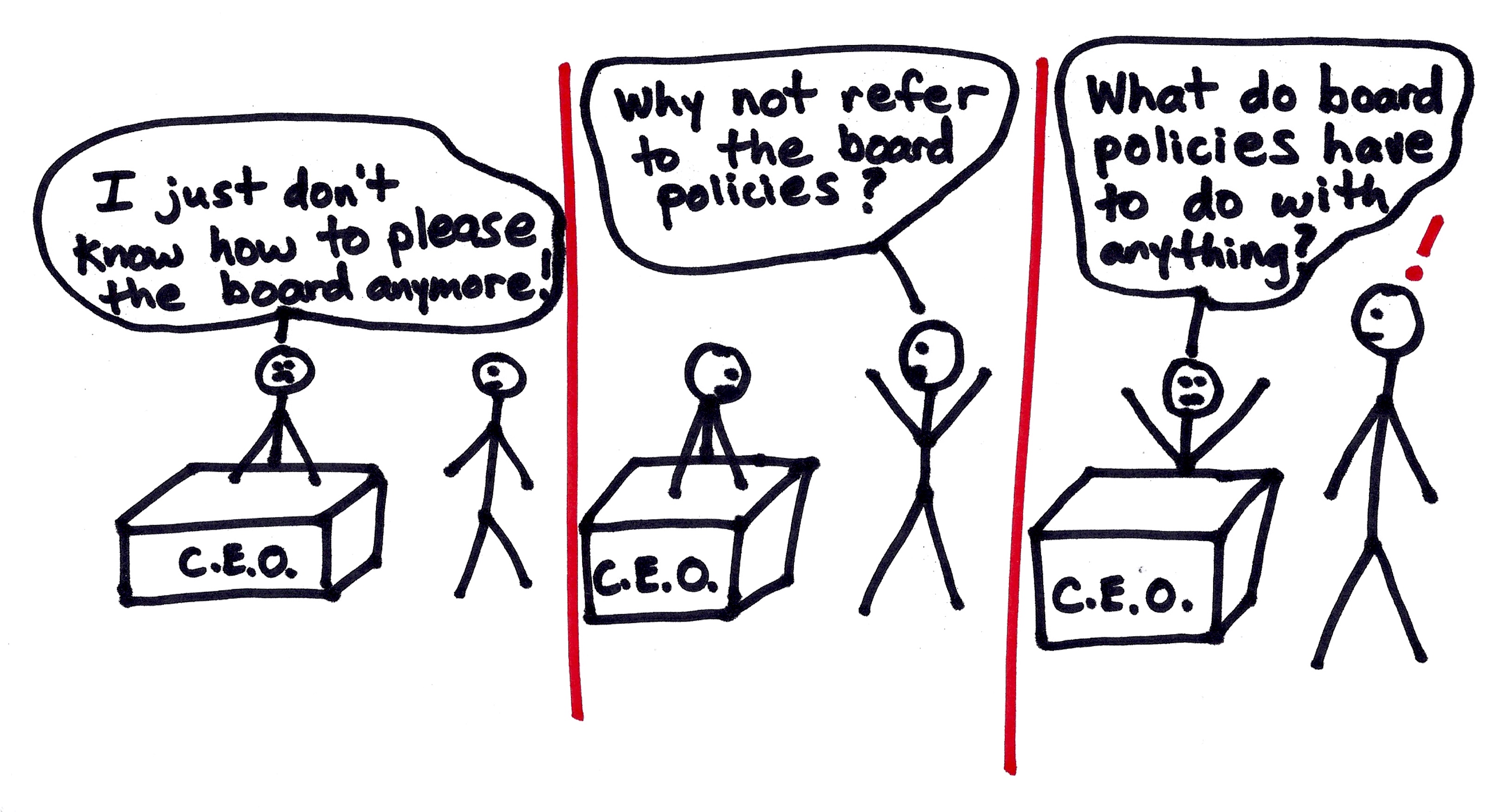
So there you go, no unilateral amendments: "prior agreement of the Association."

Development of new policy is similarly circumscribed at article 7.4:

The University will not adopt new policies or procedures that affect the terms and conditions of employment of Members, as defined in this Agreement, without the prior agreement of the Association.
So there you go again, no unilateral imposition of new policies or procedures.

Oh, and if you're wondering how exactly this agreement might be sought or obtained, well, the Framework Agreement has an answer about that as well, at article 7.7:
The forum for consultation regarding the application, development or modification of University policies shall be regularly scheduled meetings between representatives of the Association (President and members of the Executive) and the University (President, Vice-President Academic and Provost, and such others as are designated by the President).
Meetings. That's all it would have taken for the university to obtain the necessary "prior agreement of the Association." The trouble is that these "regularly scheduled meetings" haven't been happening. They stopped being scheduled before bargaining began in early 2012, so the cessation has continued through the overly long bargaining process (entering, as we are, our twelfth month without a contract). Still, there's no clear reason that they should ever have stopped, and there's no reason that they couldn't have resumed. Heck, they actually are resuming on May 28, with arbitration still to come in September.

But even so, a cessation of "regularly scheduled meetings" simply cannot justify the administration's acting as if there was no need to obtain the prior agreement of the Association.

Let me be clear. At regular intervals, the university needs to update its policies that relate to terms and conditions of employment for Association members. From time to time, too, new policies also need to be generated and approved that touch on members' employment. More than that, the Association can't unreasonably withhold its agreement for a reasonable new or amended policy.

So as I've said before -- for a university's governance to be truly collegial, its executive needs to talk to its community members. In this case at UVic, community membership is defined under the Framework Agreement as faculty and librarians, represented by the Faculty Association.

Rather than talking to the Faculty Association, and following the other obligations spelled out in the Framework Agreement, the university's executive has chosen to unilaterally impose new and amended policies on its faculty and librarians.

And that's just not cool. For pete's sake, is it so difficult just to speak with representatives of the Faculty Association?

-----------------------
Why should you care? Because policies at some stage of development or revision include:
  • communication
  • research funding management and financial accountability
  • teaching and organization of courses and programs
  • intellectual property
  • research or teaching involving animals
  • indirect costs of research
  • research policy, and
  • external research funding agreements.
These subjects matter to all of us.

Thursday, May 2, 2013

LTD and the UVic Faculty Association

Let me tell you a story.

At UVic, the members of the UVic Faculty Association fund their own LTD plan, jointly with UVic members of the Professional Employees Association: 100% of LTD funding comes from employees, and 0% from the employer. There's a Board of Trustees for the fund, three from the university executive, and one each from PEA and the UVic FA.

And you, dear colleague, should be upset by the LTD fund's governance structure and funding model. Well, unless you're comfortable with employer paternalism, zero contributions from the employer, and a very high tax rate on the plan's earnings.

Early in 2008, the trustees decided that they needed to eliminate the LTD plan's unfunded liability. Basically, an "unfunded liability" is the amount needed to pay the lifetime LTD benefits of everyone currently receiving LTD, if no money ever came into the fund ever again. It's an actuarial principle, representing a hypothetical obligation, and that's all it is. Please, please, don't make the mistake of assuming that the plan is running some kind of deficit, or that it's in debt, because the LTD plan's significant assets are growing rapidly! I'm tempted to use quotation marks to talk about the plan's "liability," but we're grown-ups, aren't we?

As of June 2008, the fund held about $3.4 million in assets, so it could only cover 36% of its total hypothetical liability. (This means that if no more money ever came into the plan, it could still cover 36% of future benefits if everyone receiving benefits remained on LTD until retirement.) In consequence, the trustees boosted the member contribution rate from 1.75% to 1.93%.

By June 2011, the fund had more than doubled its assets, to about $7M, and its funding ratio had risen to 60%. By March 2012 the numbers had increased to $8.1M and 63%, and by March 2013 the numbers had increased further to $9M and 69%.

In other words, the fund's assets are increasing by about a million dollars every year. In five years, the fund's assets have grown impressively from $3.4M to $9M, and its funding ratio has increased from 36% of its total hypothetical liability to 69%.

Doesn't this sound wise? It's just basic financial responsible that the trustees would want to cover the plan's total liabilities, right?

Three problems:
  1. the plan's income is taxed, and its current taxation rate is 43.7%. Since 2008, the plan's assets have grown by $5.6 million; the plan has paid almost $400,000 in taxes to the federal and provincial governments;
  2. the administrative structure is paternalistic at best. The employer contributes zero money to the plan, remember, but it charges a small administrative fee to manage the funds. Far more importantly, the employer has an absolute majority on the Board of Trustees. Genuine consultation with the PEA or with the UVic FA has been sadly, sadly lacking; and
  3. the "unfunded liability" and its 10-year "remedy" are purely accounting matters, without basis in reality. Back when there were zero representatives from PEA and the UVic FA, the Board of Trustees decided that it would be best to eliminate the liability in 10 years. It considered going with either 5 years or 19 years, each of which would have led to quite different contribution rates, so there was no essential reason for choosing the 10-year window.
You may be interested to know that UBC's contribution rate is roughly 1/3 the rate at UVic: 1.93% at UVic, and 0.65% at UBC. And at SFU, the LTD plan is 100% funded by the employer.

There are some differences in the three plans, so it's complicated to work through the details, but honestly, I'm having serious trouble seeing anything positive about UVic's LTD coverage for members of the UVic Faculty Association and for PEA members.

Things must change. Either someone needs to settle me down in the comments area below, or....

Thursday, April 11, 2013

Collegiality and in-house comparisons

In general, I've had very positive feedback from my colleagues about this blog, both from colleagues at my university and from those who work elsewhere. One reply, though, gave me real concern, and I've been thinking hard about it ever since. In part, that's why I slowed down my posting again, just when I'd started to develop something of a rhythm.

The objection was really that in discussing differences between academic units on campus, I was myself escalating whatever factionalism might already exist between the units, and weakening the cross-department collegiality that's the only thing encouraging all of us to speak on behalf of units other than my own. When I compared the teaching loads for History and English, for example, it was suggested that I was undermining the relationship between these two departments.

And this wasn't my intent. I don't think that's what the post did, either, but clearly at least one thoughtful person thought that it did. In consequence, I've decided it makes sense to clarify my views about collegiality, data, and differences between academic units (taking "academic units" in the broadest possible sense to mean departments, faculties, employment categories, whole universities, and really any possible community of interest within the postsecondary sector).

Fundamentally, I assume that genuine collegiality is the basis for every principled question or comment about some aspect of postsecondary educational institutions. That's not to say that we should all hold hands all the time (here's someone else, somewhere else, talking interestingly about collegiality's challenges): disagreement is extremely valuable within a collegial environment.

An academic institution needs to be operated along principles that support its academic mission. I can't believe that this needs to be said (hi, Tom Lukaszuk!), but there you go.

Tuesday, March 26, 2013

Financial fear-mongering

I'm not the least bit happy about getting into this subject: indeed, I'm not happy any time that I find myself compelled to say things about my employer that I'd rather not say. In brief, members of the University of Victoria's executive are making statements that, whether the individuals realize it or not, I'd interpret as borderline unethical tactics to discredit the well-grounded bargaining position of its Faculty Association.

It's no secret that funding is seriously tight for Canadian postsecondary educational institutions, and that government priorities are changing strangely. The province of Alberta is in the early stages of ideologically amplified financial slashing, with shocking budget cuts, so here in BC we're grateful not to be facing this -- and if I may say, intensely supportive of our Alberta colleagues as they prepare for an unprecedented struggle.

My point in this post, however, is actually a very narrow one. Today, I just don't have the stomach to deal with larger budgetary matters, so I want to take on a single aspect of the executive's campaign against the Faculty Association.

I've heard rumours of the phrase being used orally, but today, I saw it in the wild for the first time, and in written form at that. When someone in the administration executive wants to talk about financial trouble, a key factor in that uncertainty is now being identified as "the upcoming Faculty Association arbitration."

WE'VE GOT TO CALL THEM ON THIS TACTIC.

Monday, March 11, 2013

Talking unionization

Today and tomorrow, I'll be attending some (maybe all!) of the events being hosted by the UVic Faculty Association to talk about unionization in an academic setting. For the record, here's the info about the sessions, and below this outline, I'll talk about the issues in a little more detail*:
Monday, March 11: 3pm-5 pm: Mac D116: “What are the faculty union experiences at other Canadian universities?”
Panel Discussion: Dr. Neil Tudiver, Asst. Executive Director, CAUT, and Dr. Nancy Burfoot, Professor, Queens University, former President Queens FA 
Monday 11 March: 5:30 to 7:30: Wild Rose Room, University Club (refreshments and snacks provided)
Informal discussion with Drs. Tudiver and Burfoot, and UVic FA Executive Committee 
Tuesday, March 12: 2:30pm-4:30pm: Mac D116: “What does the unionization process look like, and what are the challenges?”
Panel Discussion:Dr. Neil Tudiver, Asst. Executive Director, CAUT, and Dr. Nancy Burfoot, Professor, Queens University, former President Queens FA

Thursday, March 7, 2013

Rethinking an academic department

Times are awful everywhere in the humanities, we keep reading. Anyone who has ever been part of a newspaper story recognizes the often-large gap between life and the journalistic version thereof, of course, but still: university budgets are under pressure, and everyone's got an idea about how to do more with less.

But hey, maybe the current structure isn't always the best one, you know? After all, every academic structure is really an agglomeration of traditions that in a best-case scenario seemed like good ideas at the time. This suggests that a clean, formal, professional review of curricular offerings might be both a great idea and doomed, but let's worry about that another day. For now, I'm saying simply that there's rarely (never?) a good reason to think that one lives in the best of all possible worlds.

Like many other departments around here, our English department is reviewing its curriculum, largely at the direction of the Provost's office. We like what we've built, mostly: an extremely successful Honours program, a small but potent Professional Writing minor, very good grad students, talented colleagues, that sort of thing. But if we had to build it all over again, would we choose to offer the same slate of courses that we do now, with the same class sizes?

Thursday, February 7, 2013

Gendered salary inequities

Note: This blog represents my personal views. As I've said before, I'm not writing on behalf of the Faculty Association in this or any other post. I sit on their executive, but the FA has a formal communications process (in which I participate), and the FA's page is where you should go for the FA's view on any particular issue.
-------------------------------------
One might think that universities would be places where merit and potential are judged blindly: where men and women start with similar salaries, get promoted at the same rate, and see comparable salary changes over time. It's meant to be an evidence-based environment, but the studies keep showing otherwise. Gender inequity occurs lots of areas, and it turns out that universities, indisputably, are no different.

Every university is different, so every one of them needs to look closely at the differentials in salary, promotion, status, and so on. Here in Canada recently, it was very big news among postsecondary institutions when UBC announced they'd be implementing a 2% pay increase for all female tenure-stream faculty, retroactive to July 1, 2010. The university's Equity Office looked closely at the numbers, and then the university negotiated with its Faculty Association to come up with an agreement to redress the average of $3,000 per female faculty member that couldn't be otherwise accounted for.

Here at UVic, as you might expect, the response to the UBC announcement has been a bit complicated.  We're all very pleased for UBC's female faculty, but "Why not us?" has been a common refrain. The Academic Women's Caucus has been watching over and talking about a gendered salary gap around here for a long time, and let's just say that UBC's move didn't relax anyone at UVic with gender climate concerns, especially if those concerns had to do with salary.

Wednesday, February 6, 2013

Transparency

A short post today: now that this blog is getting a heavier readership, and now that some posts are getting some traction, I'm hearing that some readers are a little worried about me.

Boiled down, the worries come down to, "Aren't you worried about what your school's executive* will do to you for blogging about your school's administrative issues?"

In brief, no.

But before this statement gets interpreted as willing martyrdom or something ("I'm my own hero!"), you need to understand this blog's current mission. All I'm doing at this point is asking for transparency. I want my university's executive to renew its commitment to the principles of collegial governance trumpeted in its strategic plan. This principle has been part of UVic's fabric since the 1970s, and since it was part of the consultant's brief for hiring a new president to start in 2013. That's hardly revolutionary.

Sure, I disagree with some of the executive's apparent goals and methods, and I'm blogging about those here as well, but that's a separate issue. Right now, I'm most upset simply that they won't talk to the university community. Interspersed with this core principle are assorted other disagreements, but that's not an issue. What community doesn't have its dissenters, and what university can't accept polite, reasoned dissent?

People seem especially anxious about my posts about the definition of "administration," about smart growth, and on the question of faculty representation, so let's take as a representative example my post on UVic's smart growth initiative.

The executive hired a consultant on smart growth, David Attis from EAB, who told them many things after (and presumably before!) he spoke with about a hundred different people across campus. One of his key comments was that faculty members needed to be engaged with, or they'd be likely to resist change; this risk has been identified in every change initiative ever undertaken at any university anywhere ever. Somehow, faculty members across campus remained unaware of the very existence of this restructuring process, and indeed the larger university community remains under-informed about, maybe even unaware of, UVic's investment in Smart Growth.

My reaction to the executive's apparent program of change is largely irrelevant to the objections I've made in this area. At bottom, I just want the executive to talk openly about its restructuring process. If they gave us some detailed numbers, explained their vision, and showed a willingness to talk, then we'd be talking about actual issues. They haven't, so we're not.

So, no. I'm not worried about blowback from my executive. I'm affirming here my commitment to a principle of collegial governance that the university's strategic plan describes as integral to the school's future. I'm sure they'd rather all of these kinds of conversations happened inside the walls, so to speak, rather than visibly, but genuine collegiality can't draw those kinds of lines.

I'm going to keep talking, because it's time for a conversation. Join me, won't you?

----------------------------------------
* And yes, I'm trying to use the term "executive" where we'd be more likely to use or hear the term "administration." A commenter helpfully pointed out that if I'm at pains to distinguish between "the administration" and "administrative tasks," maybe I need to identify more clearly when I'm talking about the executive specifically.

Monday, February 4, 2013

100,000 reasons to smile

Dear UVic executive,

I see that the lead story today on the UVic News page is "Alumni Week: 100,000 Reasons to Smile," and frankly this has broken me. We've all recognized for some time that you seem to be misunderstanding some fundamental things about the mood of your university community, and as of today, I've had enough.

We're living through constant fear of budget cuts. Staff are being laid off (in CUPE and in PEA, which has just had its second round but seems not to deserve a press release or official statement). We're seeing job non-offers to theoretically non-continuing faculty and staff with several years of service.

And you have the gall to lead your News page with "100,000 Reasons to Smile"? A phrase, mind you, that DOESN'T APPEAR IN THE RELEASE ITSELF.

As you may know, I've blogged obliquely, more than once, about your failure to explain credibly how the province's 1.5% transfer cut (to the 60% of our budget they provide) justifies a 4% cut for each and every unit across campus: see the fourth paragraph here, for example. We're all still waiting to hear how the math works in the Administrative Services Building, to translate a 1% government cut to a 4% university cut. That's not my point today, but feel free to provide a detailed, evidence-heavy explanation. Take your time.

I'm also not talking about CARSA, the parkade and athletics facility whose cost continues to rise before constructions gets started, though I've got some opinions about that, too.

No, my point today is that clearly, you just don't understand what we mean when we say "administration."

Monday, January 28, 2013

Smartening university growth

The University of Victoria has had a history of shared governance between its administration and its community. As the web site introducing the university's strategic plan notes, “UVic prides itself on collegiality and transparency in governance,” and the strategic plan itself speaks of the university’s commitment to “collegial forms of governance that provide appropriate opportunities for all members of the university community to participate.”

Many faculty at UVic will thus be surprised to know that the university has gone very far indeed down the path of consultant-driven restructuring, out of view from the campus community. As of March 2012, consultants from the Education Advisory Board had been working with the university for about 18 months and had conducted more than 100 interviews. I’m not sure who these interviews have been with, but I’m yet to hear from one of the interviewees, or to hear from anyone below the level of Chair who has been part of these discussions.

If you are interested in these matters -- and you should be, oh, you should be -- I’d very strongly encourage you to watch the 75-minute video currently located on the Provost’s web site, in which EAB’s practice manager Dr. David Attis explains the background to and principles of the “smart growth” approach that this university appears to have committed itself.

The key background you need, before you watch the video or talk about its issues, is that the university has not publicly addressed the disjunction between the province’s budget cut, and the university’s projected budget cut. As many news outlets have reported, British Columbia has cut its contribution to the operating budget of the province’s universities (including UVic) by 1.5% for the 2013/14 year. Its contribution to the operating budget is less than 60%, making this roughly a 1% cut to the university’s operating budget, but somehow the university has turned this into a 4% cut to all academic units.

Some units, I gather, have been told already that their funding cuts are being undone, and their funding at least partially restored; others have not. This sounds like restructuring, even if it hasn’t been examined in the media the same way that Saskatchewan’s restructuring has been (by CBC Saskatchewan and by the Globe and Mail). It's this possibility that lies at the heart of people's worries about the current year's cuts.

Now, as I've said before, this presentation by David Attis for EAB isn’t all bad news for faculty at UVic, or indeed for other members of the university community. Unfortunately, however, the administration seems deliberately to have gone against many of Attis’ recommendations about process. At different points in the lecture, he speaks against salary cuts, against relying on inequitable sessional labour, against increasing workloads beyond sustainable levels, and against unilateral top-down restructuring exercises. He speaks in favour of an open, campus-wide conversation about university priorities; in favour of making faculties and departments responsible for decisions about such things as class sizes; and in favour of recognizing connections between programs.

On quite the other hand, President Turpin has led conversations at Senate and the Board of Governors in recent months where salary cuts were discussed; he has suggested at least once in these meetings that the university should consider whether a greater proportion of its courses should be taught by sessional instructors. At least some decisions about workload and section sizes appear to have been centralized in the Provost’s office. The university’s arrangement with EAB appears still to be unknown to the overwhelming majority of its faculty, 10 months after David Attis told attendees at this presentation that he had been working here for 18 months and had interviewed more than 100 people. The kinds of data that David Attis describes as critical for an informed campus-wide conversation has simply not been shared.

We should be deeply concerned about the lack of fit between the consultant’s recommendations about process, and the university’s actual process. If we take seriously this institution’s pretensions to shared governance, we ought to be acting on those pretensions to raise all manner of objections to what is being rumoured to be a fairly thorough covert restructuring of our school’s academic programs.

Of course, we shouldn’t simply take the consultant’s word about anything: we should be pushing against some of EAB’s assumptions and analysis, for example, because the whole point of collegial governance is for everyone to exercise sober second thought. For example, this presentation seems to apply to UVic some conclusions derived from finance crises in assorted American states, and seems not to account carefully for Canada’s very different approach to tuition fees. But as he explicitly says at around the 16-minute mark of the video, his job “is not to tell you what to do.” His role is to provide a process and some analysis, so that we can undertake the long, difficult task of caring collectively for our institution.

In my view, the crucial section of this presentation runs between the 16- and 25-minute marks, covering slides 11 through 16. If you have ten free minutes this week, you could hardly spend it better than by watching this section.

Attis is a strong advocate for generating and sharing lots of data, and for thinking carefully about all kinds of non-financial benefits flowing from assorted programs. For example, he notes that too many schools focus on the number of Majors from separate programs, rather than (for example) the number of non-Major students who take the courses; he notes that some programs (like Nursing) are almost invariably money-losers and yet culturally valuable enough that few schools would consider closing them. Obvious decisions can still be wrong, because what's important is simply to think carefully about everything that's on the table for strengthening the institution's future.

Slide 12 is fascinating, because it plots (based on the experience of Capital University, in Ohio) the revenues of assorted programs against their financial break-even points: Capital’s one program that generated the most revenue was Law, but it was still lost money. Slide 13 looks at how many sections the university offers where there are too few students for it to break even financially: Attis isn’t recommending that each section should break even, but that the school and its separate programs should understand its functioning at this level of detail.

Presumably the University of Victoria has put precisely this data in the hands of its administration, because without it, there’d be no data guiding whatever restructuring is underway already. What the university needs to do instead is to make this data public. It needs to respect its tradition of collegial governance, a tradition that it claims to take such pride in. As far as I know, this university has never said what its approximate break-even point is for class size. My take on the university’s finances suggests that it’s around 24 students, without taking into account the need for cross-program subsidies (whereby expensive but significant programs are quite rightly supported by cheaper programs), but I’d never call that more precise than guesswork. That’s not good enough, if we’re going to work together to keep building this university’s future.

David Attis’ closing thought was that UVic should, to the extent possible, be trying to make cuts that aren’t particularly painful: “matching supply to demand within existing quality standards.” He’s interested in having classes run closer to their caps, for example, so that as often as possible, there are lots of classrooms full of keenly interested students. Faculty should want this, too. It’d mean secure employment for faculty, for one thing, and if we’re correct in our collective belief in the cultural value of institutions like this one, it’d also mean a secure future for civilization (however we define that problematic term).

Collegial governance is where I started this post, and it’s where I want to end it. I don’t think anyone working at UVic would say it’s a bad idea to think carefully about where we’re going, whether "we" means the institution as a whole or simply one of its many separate programs. Across this campus, though, I’m hearing a deep frustration from people that they’re not being allowed to participate in this thinking. If the administration persists in declining to engage with the university community, it shouldn’t be surprised if the community declines to see the administration as true community members.

Engage with us, meaningfully and openly, and we’ll work with you to make this a better place. I promise.

Tuesday, January 22, 2013

Arbitration for UVic's Faculty Association

On January 21, 2013, the negotiating team for the UVic Faculty Association sent an email on its listserv that was intended to reach all faculty and librarians. It hasn't yet appeared on our website, though, so I've posted it here for anyone who might want to share it or see it outside an email context.

As the opening paragraphs note, this bulletin owes some of its approach and tone to its role as a response to the administration's announcement about mediation. I decline to provide a link to that announcement, as it simply doesn't deserve the traffic.

-------------------------------------------


Bargaining Bulletin #14

January 21,  2013

The End of Mediation: Where are we, and what's next?

The bargaining process between the University of Victoria and the UVic Faculty Association has been long, and we're disappointed to report that the mediation phase of this process has now concluded without an agreement, just as the negotiation phase did. We wish that we could say simply that an agreement was not reached, but it's more accurate to say that both negotiation and mediation have failed to produce an agreement.

We had intended to produce a measured, careful statement about the mediation phase, respecting the collegial governance model that is often said to be a hallmark of UVic. Unfortunately, an administration announcement, dated January 18 and reflecting either a gross misunderstanding or a deliberate misrepresentation of what happened during the mediation, has necessitated a more rapid response.

Salary

During negotiations, the Association presented the administration with Statistics Canada data indicating that salaries here are not only significantly below the national average, but are, in fact, among the lowest of all research universities in Canada. The only two comparator universities with lower average salaries are the University of Manitoba, and the University of New Brunswick. The administration declined to discuss these data.

During the October phase of mediation, the administration offered a 2% raise in each of the agreement's two years. Manitoba had a 2.9% increase for 2012; New Brunswick has 3.5% increases for each of 2012 and 2013. If we had accepted the administration's offer, the consequence would be that UVic's average salary would be the lowest, without exception, among the 21 schools that the administration views as our comparators.  We would also have fallen further behind at least 17 of these comparator institutions: not only would our average salary be the lowest, but it would be further below the average than it is now.

During the January mediation, we indicated to the mediator a willingness to repackage our request in different ways, including a 2+2 settlement with a 2-year increase in CPI as an alternative to a percentage increase. The administration’s claim is that we presented them with a “take it or leave it offer”. This is highly misleading, whether deliberately or otherwise: at no time did we indicate that we would stop negotiations if they produced a counter-offer which came short of our proposed settlement.

Ability to pay

The Association recognizes that this university, like every public institution (and indeed every private one), faces financial pressures of one kind or another. To describe UVic as unable to pay a settlement that would prevent it from being the lowest-paying university of its kind in Canada, though, is a stretch at best.

For one thing, it means that we would need to ignore the “unexpected” surplus that this university has run in each of the last several years, which the administration was pleased to tell the Board of Governors was $20.3 million in 2011/12 alone.

Take the current 4% budget cut that is being imposed across all units, for example. The impetus behind this cut has been publicly described, repeatedly, as the province's projected cut to grants into the university's general operating fund. The province is indeed cutting this grant, but only by 1.5%, and this grant represents significantly less than 60% of revenue into the operating fund. How does the province's decision to reduce its contribution to the university's operating budget by less than 1%, lead to a 4% cut by the administration?

Fundamentally, the Association in no way accepts the administration's claims about its ability to pay a fair settlement.

“Take it or leave it”

Finally, the administration's statement declares that the Association ended mediation by presenting what the administration calls a “take it or leave it” package. Nothing could be further from the truth.

The administration opened this final day by indicating that they would be willing to discuss the outstanding non-monetary matters, but only if the Association would a prioriaccept the 2/2 offer, thus making UVic the country's lowest-paid school of its type. Even at that, their “take it or leave it” offer came with no agreement of any sort to accept any element of our non-monetary proposals (including on the promotion tenure/reappointment issues we discussed at length with the membership in past bargaining bulletins) – only a non-committal “agreement to discuss.”  So we had to agree to falling further behind other Canadian institutions in exchange for the prospect that we might (or might not) see some non-monetary improvements. In no uncertain terms, the mediator reported to us that the other side was unwilling to discuss non-monetary matters further in the absence of a monetary agreement on the administration’s terms.

In other words, from our perspective, the only side making a “take it or leave it” statement was the administration.

Indeed, the very last thing that happened in mediation was that we offered to send all non-monetary matters to binding arbitration, along with monetary matters. The administration refused. It had no interest in resolving the non-monetary matters it describes in its bulletin; it was prepared to talk about them – not to agree with our proposals, but to talk about them – only if we agreed that this university's faculty and librarians should be lower paid than if they were employed at any other comparator school in the country.

The administration's description of this final moment as a “take it or leave it” package presented by the Association is so far from reality that we call on them to revise their bulletin and apologize for this mischaracterization of the mediation process.

What's next?

In brief, arbitration is the final step in negotiations. No date has yet been confirmed, but it is not likely to occur within the next month or two.

Financial matters will be presented to Colin Taylor, who has so far been the mediator and will now become the arbitrator, and he will be responsible for a determination that may select either side's position in total, may draw elements from both positions, or may fall between the two side's positions.

Non-monetary matters are not being presented to Mr. Taylor, because the administration refused to accept our proposal that he be asked to decide on those as well. In consequence, the current Framework Agreement is being rolled over for an additional two years, with the inclusion of whatever changes were agreed to during negotiation and mediation.

As for what happens next, as in what's next for the relationship between the administration and the Faculty Association, and the Association's members, we hope you'll reflect carefully on that.

We look forward to hearing from you, and to seeing you at the upcoming General Membership Meeting scheduled for 3pm on Thursday, February 14.

Friday, January 18, 2013

Smart growth

I want to start simply with a brief note, in part because I'm too tired to know what to do with everything I'm thinking about UVic's in-progress efforts toward smart growth. The process is influenced heavily by the Educational Advisory Board consultancy practice, which appears to be led by David Attis.

Over the last few days, I've put a lot of time into following up clues from the Provost's web site, including this video by Attis, accompanying a suite of complex, valuable slides. My gut reaction is that this process could work out positively at UVic, but a few things have me really worried.

First, Attis notes several times that faculty need to be involved in this process, because faculty are the only ones with the intimate, disciplinarily appropriate knowledge to know the right questions to ask, and to answer these and other questions. At the time of his presentation, maybe 10 months ago, he mentions that he's been involved for 18 months and has done 100 interviews.

In every way that matters, I'm just another faculty member, even though I'm on the Faculty Association executive, and even though I coordinate the university's first-year composition course (the university's single largest-enrollment course, with more than 2000 students). But I work hard to stay plugged in, to know what's going on, because I'm keenly interested in the evolution and the future of this institution.

And someone else stumbled across this 10-month-old video and told me about it. That's the only reason I've now seen this video, and I'm not finding any other faculty members who know about it.

Second, this process can only work -- can only avoid generating confrontation, flashpoints, worse -- if it's handled sensitively, perceptively, and carefully by the university administration. The behaviour of the administration's representatives during contract negotiations and mediation have ... well, have not emphasized these qualities.

Third, the University of Victoria has long prized its more or less collegial governance. This "smart growth" process depends on big data, generated only through deeply searching through the university's databases, and so far, the administration has held its data close. This data MUST BE SHARED. If the administration refuses or declines to release its data into the university community, to be parsed and reconsidered and ruminated upon, the university community will see this as an assault on collegiality.

Let me repeat: the consultant's presentation describes a process that I really believe could have positive outcomes at UVic.

But the outcomes can only be positive if this university's administration is prepared to be transparent, respectful, and open. David Attis and the Education Advisory Board need to lean heavily on this administration to do this, or their good work will all go for naught -- or worse.

Wednesday, January 16, 2013

UVic and its comparators

Which Canadian universities are similar to UVic, in the eyes of UVic's administration? Data is never neutral, obviously, so it's important that we look closely at their perceptions.

For several years, the Faculty Association has assumed -- and stated its assumption -- that the university's comparators are those that the Board of Governors uses for setting the salary for senior administration. There's some discussion of that original comparator list (including faculty salaries and administrators' salaries) in Bulletin #5 from March 2012.

During bargaining, though, the administration provided a considerably expanded list of comparators. It strikes me as peculiar, at best, to say that the same institutions shouldn't be used for the assessment of these different employee groups (administration on the one hand, librarians and faculty on the other). It smells a little like a class issue, frankly, a distinction simply for the sake of distinction.

Setting that aside for now, here's the administration's longer list, with asterisks marking those on the original list. I've included what Statistics Canada believes to be the 2010/11 average salary at each institution, but including Deans (to the nearest hundred dollars):
  • University of Toronto: $136,500
  • *Queen's University: $133,400
  • *McMaster University: $131,700
  • *Guelph University: $127,300
  • *Waterloo University: $127,200
  • York University: $126,700
  • University of Alberta: $126,500
  • *University of Calgary: $117,700
  • University of Windsor: $117,000
  • University of Ottawa: $115,800
  • *University of Saskatchewan: $114,800
  • *University of Western Ontario: $114,800
  • University of British Columbia: $114,400
  • *Carleton University: $114,400
  • *Memorial University: $110,600
  • *Simon Fraser University: $109,400
  • *Dalhousie University: $108,000
  • *Wilfrid Laurier University: $105,300
  • University of Victoria: $105,000
  • University of Manitoba: $104,200
  • University of New Brunswick: $103,800
CAUT has some slightly different numbers, because they seem to have been able to separate out the Deans. I can't find those right now: they barely change the rankings, though some of the gaps shift. In January 2012 we posted a bulletin discussing some of that data, but that's before we knew the comparator list was going to expand.

We're ahead of only Manitoba and New Brunswick, but we know a little extra about those schools.

Manitoba is very similar in size to UVic, and while it has no 2013 settlement yet, its 2012 increase is 2.9%. The administration's offer would thus result in a dead heat with Manitoba after the first year.

New Brunswick is slightly less than half the size of UVic, so it's not an exact comparison, but on the other hand, they're getting 3.5% raises in each of 2012 and 2013. Our administration's offer would leave us, in fact, behind UNB after the second year of the contract.

Which, to be clear, would mean that UVic's salaries would be the lowest in the country.

Friday, January 11, 2013

UVic humanities teaching loads

There's a little extra controversy this year among departments in the Faculty of Humanities here at the University of Victoria, about the different teaching loads for faculty in different departments. Now, this is precisely the kind of thing that Humanities faculties the world over specialize in, internecine sniping of one kind or another, but that's not what's going on here.

The issue is straightforward. In 2010/11, the Department of English proposed the the Dean a plan whereby they'd be able to move from a 3/2 teaching load for research faculty, to a 2/2 load (from 5 to 4 courses per year). It wasn't a perfect plan, but it really did have only a small cost to the Dean. The Dean, though, asked the department to defer for a year, so that other departments had a chance to move to 2/2 as well. Recognizing the value of solidarity, English agreed.

(An external review of the department, by the way, was what triggered the effort in the first place: the reviewers felt that the faculty's publication record and reputation meant it ought to be at the 2/2 disciplinary norm in this country for research-intensive schools.)

During 2011/12, most of the Humanities departments developed 2/2 plans that were approved by the Dean. At the end of the road, though, the Provost decided that everyone could move to 2/2 -- except English, which would have to remain at 3/2. And there was great rejoicing amongst English research professors, as you might imagine.

The ultimate reason remains somewhat obscure, but it has something to do with delivery of first-year composition, something to do with the department's use of sessional instructors, and something to do with the teaching load for regular faculty. I've written elsewhere already about the comparison between sessional faculty and regular faculty, and I've started looking at the enormously complicated question of first-year composition, but the one thing I hadn't yet done was compare English to other departments.

English is the largest Humanities department, and the Department of History is the next-largest. It therefore makes sense to compare the two of them, because if relative teaching load was a factor in the Provost's decision, the data should clearly support that. I've excluded sessional instruction in both departments, as well as individual supervisions and teaching performed by faculty members from other departments.

Here's what you find for the 2011/12 calendar year:
  • average number of sections taught per faculty member: History 3.28, English 3.49;
  • average number of students per section: History 25.80, English 24.97; and
  • average number of students taught per regular faculty member: History 84.52, English 87.08.
In other words, even though many of History's courses have larger cap sizes, 2011/12 saw only marginal differences between the teaching loads of History professors and English professors at the University of Victoria. History professors taught slightly larger classes, and English professors taught slightly more students.

Data on comparative teaching loads simply cannot be the basis for preventing English research faculty from moving to 2/2, and for allowing History to make the move.

The digging continues. Up next, some thoughts about the role of sessional instruction in different Humanities departments; the differences between literature instructors and composition instructors; and analysis of teaching loads in additional Humanities departments. Stay tuned!

Tuesday, January 8, 2013

On representation, and faculty salary discussions

If you're a member of the UVic Faculty Association, and you have even a passing interest in salary issues, you're going to want to check in with your elected representatives both to Senate and to the Board of Governors.

Some background, first.

The University of Victoria sees itself among a cohort of 21 comparator universities, on the matters of research, library holdings, and other things, including salaries for FA members. There are some slight variations depending on what category you're looking at, but it's abundantly clear that salaries for FA members are very nearly the lowest among the entire cohort. Statistics Canada says so; dig through their full annual report, if you don't believe me.

Librarians aren't right at the bottom, but they're low. Faculty salaries, though, are 20th out of 21, ahead of only the University of New Brunswick, a school half the size of UVic whose faculty have bargained for 3.5% salary increases for both 2012/13 and 2013/14.

In the spring of 2012, less than a year ago, the UVic FA surveyed all its members about priorities for the ongoing round of bargaining. Around 50% of members responded, and the results of that survey are summarized briefly here. On the salary question:
  • 56% of respondents said that the FA should "bargain aggressively to achieve something close to the Canadian average university salary";
  • 32% said that the FA should "bargain hard to improve the relative salary position of UVic Faculty Association members";
  • 11% said that the FA "should seek improvements, but should not push too hard for salary increases"; and
  • 1% said that the FA "should accept any reasonable salary proposal the university administration feels it is able to provide."
When we asked members to choose where the FA negotiating team should focus its energies, 77% ranked a scale increase the highest priority, with 11% each preferring CPI and merit increments.

At Senate last week, which by the way is an open meeting, so anyone is free to attend the open portions of sessions, one elected faculty member asked whether it made sense in the current budgetary climate to halt the payment of merit increments altogether. Another elected faculty member asked how to go about starting a conversation about salary cuts; the university's president advised that this idea should be raised with the FA President.

Let me reiterate: two faculty members elected to Senate spoke there last week in favour of reducing the salaries of UVic FA members, not just compared to other institutions but in absolute terms. Do these comments represent your views?

I'll post again soon about the university's finances, but let me leave you with a few points.

First, of course it's true that no public institution has a blank chequebook. The BC government has announced a 1.5% cut to UVic's operating grant for the 2013/14 fiscal year, so there's genuine pressure on the university's budget. However, the administration told Senate last week that this grant covers only 56% of the university's budget. Somehow this has been used to justify 4% cuts to the budgets of academic departments. Do you trust them?

Second, this institution has consistently run "surprise" surpluses, sometimes significant ones. Between March 31, 2008, and March 31, 2012, UVic's financial officers projected a cumulative deficit of $6.7 million dollars. Instead, the audited financial statements show that across this period, the university in fact ran a cumulative surplus of $86.8 million dollars. That's an average surplus of over $17 million. (Bear in mind that a 1% increase to FA salaries would cost the university about $1 million.) How do you feel about the coming 4% cut now?

And what would you like to hear your elected representatives say, next time the issue of FA salaries comes up at Senate or the Board of Governors?

Thursday, December 20, 2012

UVic names new President

Below is the text that I'd intended to use for our new President. I can't run it now, because it's Jamie Cassels. He's not an outsider; he's the ultimate insider.

And it'll be disastrous for each and every item in my list of brewing troubles below, because most of those things can be traced in one way or another, and to varying degrees, to his time as this university's Provost.

Colour this faculty member deeply, deeply disappointed with this news.

I'll reflect, and consult, and do the research, because that's what academics do, but .... Good heavens, what has this search committee DONE?!?!?

---------------------

Well, I for one welcome our new administrative overlords.

These are challenging times for a university's new president, and UVic isn't much different than anywhere else. This blog was born out of my need to critique this university's strategic plan, and while I haven't continued that quixotic task, I continue to feel that it's necessary. My administrating and critiquing have simply had to move on to other targets: collective bargaining (since I'm on the association's Negotiating Team, about much of which I've had to remain fairly quiet), departmental organization (the Department of English, an invariably complicated place at any university), and first-year composition (a battle over tuition fees, and between visions).

For today, I'll say only a polite welcome to [insert name here], who until recently was the [position].

Mind you, I should also say that I look forward impatiently to seeing:

  • if you can exert some positive influence over the last few years' deterioration in the relationship between faculty and administration, and between the Faculty Association and the Administration;
  • if you can slow the proliferation of upper administrative posts (a doubling of Associate Vice-Presidents in the last five years);
  • if you can slow the parallel proliferation of middle administrative posts (such as the impressive staffing increase surrounding Deans);
  • if you can limit the success and reach of the assorted empire-building projects that have always been (and will always be) part of university structures; and
  • if you can get UVic to live up to its long-ignored obligations under the University and College Presidents' Climate Change Statement of Action for Canada. As I've written before, this failure is absolutely characteristic of the current university administration, including its tendency at times toward PR rather than policy.
We'll be watching.

Friday, October 19, 2012

Coming changes

Time to reinvigorate this site, I think -- and to recruit some additional authors. If you have something to say about UVic's assorted strategies and directions, whether about the Strategic Plan or about something happening in a specific corner of the university, let's see if we can generate some conversation here about that issue.

In the coming weeks, regular posts will resume on this blog. Stay tuned.

Wednesday, February 8, 2012

Bring on the new plan already

What's the university administration waiting for?

On January 6, 2012, the university's Senate approved the revised draft Strategic Plan. The vote wasn't unanimous, but it passed comfortably, as these things always do. A month later, the plan remains embargoed and not available for public consumption.

I'm assuming that they want to see the back of the recent payroll theft media coverage before they put something else out into the media/PR cycle, but nobody's said as much.

Bring it on. Wait much longer, and we're going to think you're rudderless! Besides, I've got some time the next little while to start digging into the revision, comparing it to the comments I've collected from people who provided submissions into the review process....

Wednesday, November 23, 2011

On freedom

While I've been spending so much painful time watching and thinking about recent Occupy-related protests on American university campuses, I've been thinking again about fundamental values, both those spelled out in UVic's draft Strategic Plan and those I tend to hold dear. Here are the Plan's declared values:
The following fundamental values will inform all of our actions and are a prerequisite to fulfilling the purpose of the university:
  • intellectual and ethical integrity
  • freedom of speech and freedom of inquiry
  • equal rights and dignity of all persons.
And here's what I sniped a few weeks ago:
So ... the basic assumptions of a democratic society and of any university anywhere ever, some of which are entrenched in the Canadian Charter of Rights and Freedoms? THOSE are the fundamental values of this university?
Handy PR tip: claiming as a "fundamental value" the nation's legal minimum standards may not be as impressive as you think.
I went on to say that the university, as a matter of principle, needs to take on leadership roles in areas that it feels are important, and that this draft statement of fundamental values failed to do that. My focus throughout this blog so far has been on ecological principles, but let's set that aside for now.

Events at UC-Davis, in particular, have suggested that, in assuming near-absoluteness for freedoms of expression and inquiry, maybe I'm giving too much credit to The Powers That Be. If police in Seattle can pepper-spray an 84-year-old woman not actively protesting, then maybe I shouldn't assume that my right to declare myself peacefully will be respected. If New York police can throw a self-proclaimed library in a dumpster, then maybe I shouldn't assume a broad cultural respect for independent intellectual inquiry. If the University of California's own security staff are so ready to use pepper spray against students sitting on a sidewalk in protest, then maybe other universities' security staff are similarly ready to take similar action. Maybe security staff are ready here at UVic to do this: please understand, I say this not to impugn them, simply to insist that the individual YouTubed experiences we're all watching can and must be generalized to other individual circumstances.

To that extent and for those reasons, I'm now somewhat more tolerant of the draft Fundamental Values: the university really does need to reaffirm its belief in and support for these abstract principles of freedom, integrity, and dignity.

But you know what? I'm embarrassed by it, both by my tolerance and by the need for reaffirmation. I've spent years and years thinking that human civilization was ready to reach further and do more, with this a core part of my desire toward activist change, and yet here we are, once again pledging allegiance to established principles of justice. Good on UVic for making the pledge.

But it hurts, it really does hurt, to know that maybe we're not equipped to do any better than we've been pledging to do for so many years.

--------------------------------------------
Additional reading:

Sunday, November 13, 2011

Marketing UVic greenly

I've had a hard time figuring out how to express this, but here's what one element of my frustration with UVic's 2011 draft Strategic Plan comes down to: the university's selling sustainability broadly and supporting it narrowly.

Take the fall/winter 2011/12 Green Guide, for example. Distributed as part of the Times-Colonist today (Nov. 13/11), subtitled A Resource Guide for Sustainable Living, and with its three lead sponsors being the TC itself, the CRD, and the university, it should make me happy to see UVic involved with it, but it doesn't. Sure, I'm glad that information makes it out there about battery recycling and low-VOC paint for kids' rooms and whatnot, but as it says on top of every page, this is "An Advertising Feature."

The Green Guide does include stories about UVic faculty involved in sustainability research and education, so that's great. In spite of my longstanding and deep discomfort with business and capitalism, I'm extremely proud of our Gustavson School of Business and its recently opened Centre for Social and Sustainable Innovation (led by the inestimable Dr. Monika Winn). The online course modules on climate change developed by the Pacific Institute for Climate Solutions are proving both useful and valuable, and the university's research efforts toward green marine propulsion are to be congratulated.

But my first point is that faculty involved in these initiatives should be able to point to the Strategic Plan and say, "The university supports this work, as a matter of principle." Right now, the draft Plan offers no such explicit support.

My second point has to do with marketing more purely. When Maclean's wanted a photo to represent UVic on its page for BC universities, UVic provided a photo of an Environmental Studies student with a laptop, walking on rocks across water in Mystic Vale: very green-seeming. The draft Plan itself includes one photo of an ES sessional faculty member, I think from a course she teaches outside UVic proper at the Redfish School of Change, and another photo of students working at a local beach. And then there are the ads in the Green Guide and elsewhere.

If we can't point to specific items in the Strategic Plan and say, "This is how and why the university supports sustainability," then it's hard to read it as anything more principled than a marketing approach.

I'm proud of the university's efforts towards food security and supporting local food producers, so it's fine by me that the university promotes these activities in advertising. But when the Green Guide ad about campus food initiatives leads with "The University of Victoria is well-known locally for its beautiful campus and its strong commitment to sustainability," well, I need to know just where this commitment is explicitly articulated. The Strategic Plan doesn't make any such commitment, except for campus operations, just like every other university is working towards. If the Strategic Plan isn't the repository for the university's commitments, this leads me to two questions:
  • what exactly is this Strategic Plan going to be used for?, and
  • where else should I look for the university's list of commitments, anyway?